Swiss VIN Decoder

Decode your chassis number and get the official technical data of your vehicle

What is a VIN number?

The VIN (Vehicle Identification Number), also known as the chassis number, is a unique alphanumeric code of 17 characters assigned to every vehicle produced worldwide.

This number is standardised worldwide according to the ISO 3779 standard (published in 1977, mandatory since 1981) and uniquely identifies each vehicle. It contains information about the manufacturer, technical characteristics and serial number.

Unique

No two vehicles in the world share the same VIN

Standardised

ISO 3779 standard since 1981

Tamper-proof

Engraved and protected against fraud

On the Swiss vehicle registration document

The VIN can be found in field 23 of your vehicle registration document. In field 24, you will find the type approval number.
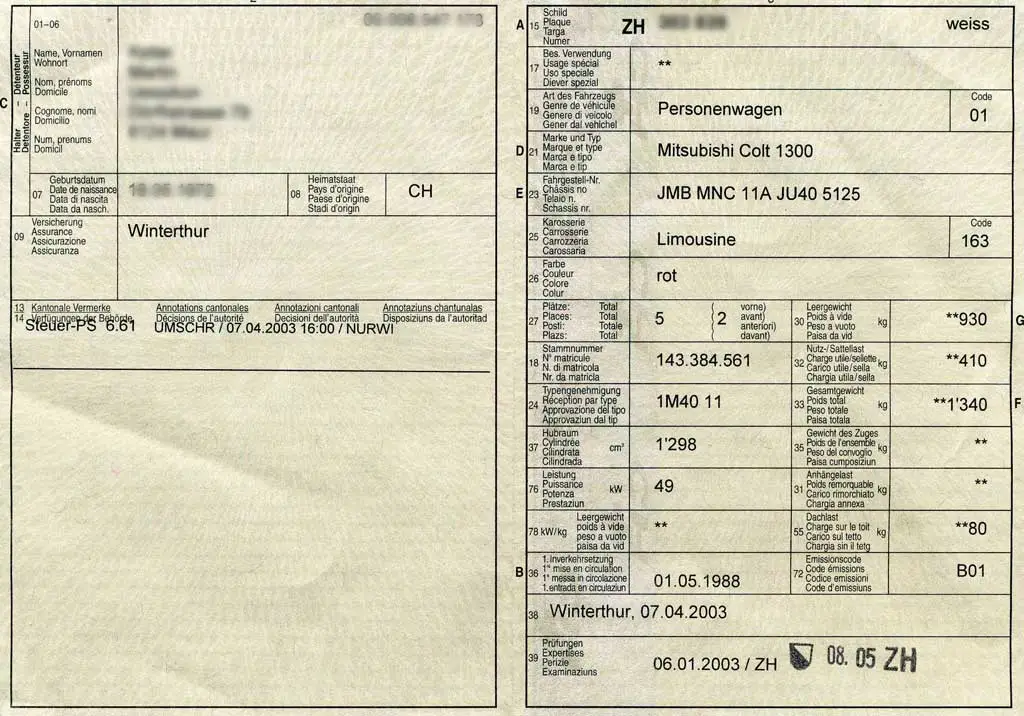
Where to find the VIN number?

On the Swiss vehicle registration document

Swiss vehicle registration document - Field 23 contains the VIN (chassis number)
Swiss vehicle registration document (mobile) - Field 23 contains the VIN

Field 23 (highlighted in red) contains your chassis number (VIN).

Official documents

  • Vehicle registration document (field 23) Most reliable source
  • Insurance contract In the vehicle details
  • Purchase invoice New or used
  • Service booklet First page

On the vehicle

  • Dashboard (left side) Visible from outside through the windshield
  • Driver's door pillar Label visible with door open
  • Engine compartment Engraved or on a plate
  • Chassis / boot Under the carpet or near the spare wheel

VIN number structure

The 17-character VIN is divided into three main sections according to the ISO 3779 standard:

Position Name Content
1-3 WMI
World Manufacturer Identifier
Manufacturer code and country of origin
Pos. 1 = region/country, Pos. 2 = country, Pos. 3 = manufacturer
4-9 VDS
Vehicle Descriptor Section
Vehicle characteristics: model, body type, engine, transmission
Pos. 9 = check digit (mandatory in North America)
10-17 VIS
Vehicle Identifier Section
Pos. 10 = model year, Pos. 11 = assembly plant, Pos. 12-17 = serial number

Decoding example

WVWZZZ3CZWE123456
WVW Volkswagen AG (Germany)
ZZZ3CZ Golf, 5 doors
WE123456 Year 2023, Wolfsburg plant

Forbidden characters

The letters I, O and Q are never used in a VIN to avoid confusion with the digits 1 and 0. The VIN only uses 33 characters: A-H, J-N, P, R-Z and 0-9.

Model year codes (position 10)

The 10th character of the VIN indicates the model year of the vehicle. The code repeats in a 30-year cycle:

Code Year Code Year Code Year
A2010L2020Y2030
B2011M202112031
C2012N202222032
D2013P202332033
E2014R202442034
F2015S202552035
G2016T202662036
H2017V202772037
J2018W202882038
K2019X202992039

How to distinguish between cycles?

Since the code repeats every 30 years, position 7 is used to distinguish cycles: a digit = 1980-2009 cycle, a letter = 2010-2039 cycle. The model year may not match the calendar year of manufacture (a vehicle produced in autumn often carries the following year).

Common manufacturer codes (WMI)

The first three characters of the VIN identify the manufacturer and country of origin:

Germany

WVWVolkswagen
WBA, WBSBMW
WDB, WDCMercedes-Benz
WAU, WUAAudi
WP0, WP1Porsche
WF0Ford (DE)
W0LOpel

France / Italy

VF1Renault
VF3Peugeot
VF7Citroën
VR1DS Automobiles
ZFAFiat
ZARAlfa Romeo
ZFFFerrari

Japan / Korea / Sweden

JTDToyota
JHMHonda
JN1Nissan
KMHHyundai
KNAKia
YV1Volvo
TMBŠkoda

Country codes (1st character)

A-H = Africa | J-R = Asia | S-Z = Europe (including TA-TH = Switzerland) | 1-5 = North America | 6-7 = Oceania | 8-9 = South America

What is the VIN number used for?

Used car purchase

Verify the identity and technical data of the vehicle before purchase

Spare parts

Exact identification to order the correct original parts

Insurance

Correct identification for contracts and claims

Import

Verification of approval during import

Manufacturer recalls

Check if your vehicle is affected by a safety recall

Type approval certificate

Obtain FEDRO technical data and export as PDF

In Switzerland: VIN and Stammnummer

Switzerland uses a dual vehicle identification system:

VIN (Field 23)

  • Assigned by the manufacturer
  • 17 alphanumeric characters
  • International standard (ISO 3779)
  • Contains the original technical data

Stammnummer (Field 18)

  • Assigned by FEDRO (ASTRA)
  • 7 digits (format XXX.XXX.XXX)
  • Exclusively Swiss
  • Administrative and legal tracking

During the vehicle inspection (MFK)

During the MFK vehicle inspection, the inspector physically verifies that the VIN engraved on the vehicle matches the one recorded in the vehicle registration document. This is a mandatory anti-fraud measure.

Frequently asked questions

The letters I, O and Q are never used in a VIN to avoid confusion with the digits 1 and 0. This rule is defined by the ISO 3779 standard and EU Regulation No. 19/2011. If your VIN contains these letters, it is probably a reading error.

Vehicles manufactured before 1981 may have a shorter VIN (11 to 17 characters) as the ISO 3779 standard was not yet mandatory. Before 1966, no standard existed at all. In this case, try searching by type approval number or by make/model on SwissCarInfo.

The VIN itself only contains the original characteristics of the vehicle (manufacturer, model, engine). To find out the history (accidents, maintenance, mileage), you need to consult specialised services. SwissCarInfo provides the official technical data of the vehicle (FEDRO type approval certificate).

VIN (field 23)

Unique number for each individual vehicle

Type approval (field 24)

Code shared by all vehicles of the same approved type/model

Tip: Searching by type approval number (field 24) is generally more precise for obtaining technical data.

The 9th character of the VIN is a check digit mandatory in North America (USA/Canada) since 1981, but not in Europe. It is calculated by converting each character to a numerical value, multiplying by a position factor, then calculating the remainder of division by 11. The result is a digit 0-9 or the letter X (for 10). In practice, many manufacturers include it globally.

IVI or IVIX in field 24 means that your vehicle was approved via the electronic eCOC (Certificate of Conformity) system. In this case, search instead for the Stammnummer in field 18 of the vehicle registration document (format: XXX.XXX.XXX).

The 17-character VIN has been mandatory since 1981 in the United States and Canada. The ISO 3779 standard was published in 1977. In Europe, the first requirements date from EEC Directive 76/114 (1975), reinforced by EU Regulation No. 19/2011. Before 1966, no standard existed and manufacturers used their own formats.

Check these points:

  • The VIN contains exactly 17 characters
  • No letters I, O or Q are present
  • The first 3 characters (WMI) correspond to a known manufacturer
  • The VIN engraved on the vehicle matches the one on the vehicle registration document
  • For North American vehicles: the check digit (pos. 9) is correct

Our database is synchronised daily with official FEDRO (ASTRA) data. We reference over 732'443 vehicles. Last update: 13.03.2026.

Decode a VIN

Allowed characters:

A-H, J-N, P, R-Z and 0-9

SwissCarInfo database

  • Vehicles 732'443
  • PDF certificates 43'920
  • Brands 1'996
  • Last update 13.03.2026

Full data access

Export official FEDRO type approval PDF certificates.

Create a free account View pricing